
Damage to pallet racking is an unavoidable reality of operating a warehouse – everyone’s aware of that. What people aren’t quite so aware of is what to do when this kind of damage occurs. After discovering racking damage, warehouse teams often cordon off the affected bay, request a contractor, and wait days, weeks, or even months for an external team to complete the replacement, causing operations to slow or stop. Which, of course, is fair enough.
However, there is a safer and far quicker way to manage these events. A professional Rack Maintenance Training Course equips your internal team with the technical skills needed to correctly remove and replace damaged pallet racking components themselves. It’s just as safe, just as compliant, but much, much quicker. In this article, we’re going to take a look at the 5 main advantages that a Rack Maintenance Training Course offers your staff and business.
Key takeaways
- Drastic downtime reduction: In-house repair capabilities allow qualified personnel to resolve racking damage in hours rather than days or weeks.
- Assured compliance: Training aligns internal maintenance processes with BS EN 15635 standards and incorporates recognised SEMA best-practice guidance, including the SEMA Code of Practice for the Use of Static Pallet Racking and established inspection methodologies widely used throughout the UK storage equipment industry.
- Proactive risk management: Staff develop an acute eye for structural hazards, allowing them to classify damage accurately and execute safe component replacements.
- Optimised safety teams: Establishing a small, agile team (ideally 3 to 6 delegates with scissor lift experience) maximises site safety and repair efficiency.
- Closed-loop infrastructure: Internal capabilities smoothly reinforce existing safety networks, linking regular inspections directly to fast, accurate in-house repairs.
1. Major cost savings and reduced operational downtime
We’ll start with the business benefits (as this tends to be the most appealing factor). Warehouse staff should immediately offload a damaged internal racking bay to prevent structural collapse.
If you rely solely on external contractors for minor repairs, that bay remains unusable until the contractor arrives. In a busy warehouse, losing racking bays can bottleneck operations and compromise order fulfilment speeds.
Developing an in-house repair capability allows your business to drastically reduce this operational downtime. Instead of waiting weeks for external scheduling, your trained internal maintenance personnel can execute repairs quickly. Because they’re already on-site, the transition from identifying damage to safely executing a replacement can happen in hours rather than days.
2. Compliance with European standards and best practices
Warehouse safety isn’t just an internal policy – it’s governed by strict statutory frameworks and industry standards. In the UK and Europe, one of the key standards for static storage systems is BS EN 15635 (Steel Static Storage Systems – Application and Maintenance of Storage Equipment). This standard places a clear responsibility on warehouse operators to make sure their racking structures are systematically inspected, maintained and repaired by competent people.
A professional rack maintenance course aligns your internal team directly with BS EN 15635 guidelines while incorporating recognised SEMA best-practice guidance on racking inspection, damage assessment and safe maintenance procedures. Rather than relying on guesswork or makeshift, non-compliant repairs, your staff learn compliant methods. They gain the knowledge required to assess structural integrity, identifying component codes of practice and classifying damage levels accurately. Upon successful completion of a high-quality course (like that offered by SEE Racking Inspections), delegates receive a validated Certificate of Attendance (valid for three years), providing tangible proof that your business prioritises safety and compliance.
3. Improved hazard identification and risk management
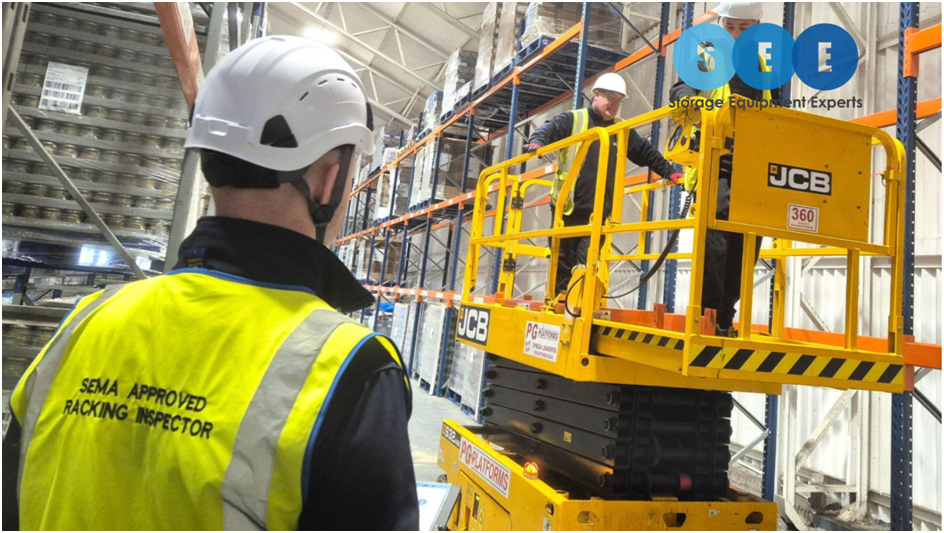
Unfortunately, effective pallet racking maintenance means more than just twisting a wrench or tightening a bolt – you need to have a working knowledge of structural risk factors. A comprehensive training programme balances classroom-based theory with hands-on practical exercises to build an overarching safety mindset.
Staff don’t just learn how to replace a component – they learn why the component needs to be replaced and how the entire structure interacts under load. Through dedicated modules on hazard identification, damage classification and housekeeping requirements, your maintenance staff develop a keen eye for warehouse risk factors.
4. Creation of an agile, skill-certified internal team
Investing in professional training directly improves the morale, safety culture and technical capabilities of your warehouse workforce. It transforms maintenance from a generic, reactive role into a specialised, safety-critical discipline. The ideal candidates for this training are warehouse maintenance personnel who already hold existing maintenance responsibilities, have basic tool experience and are comfortable working at height.
By training a small cohort of staff (typically a minimum of three and a maximum of six), you create a highly agile, coordinated internal team that can compliantly handle a wide number of racking scenarios. It’s like having the warehouse equivalent of “The A-Team” on your side (if you’re old enough to remember that show).
5. Smooth integration with existing safety protocols
Having an internal maintenance capability doesn’t replace your existing warehouse safety systems – it strengthens them. Importantly, these internal efforts work hand-in-hand with independent inspections carried out by a SEMA-approved racking inspector.
When an independent inspector identifies components that need replacing, your newly trained internal team can instantly action the report. They can review the inspector’s damage classifications, retrieve the correct spare components and execute repairs in full alignment with the recommended guidelines. This creates a closed-loop safety system where hazards are identified systematically and resolved internally without delay, raising the baseline safety standard of your entire facility.
Develop your in-house repair capability with SEE Racking Inspections
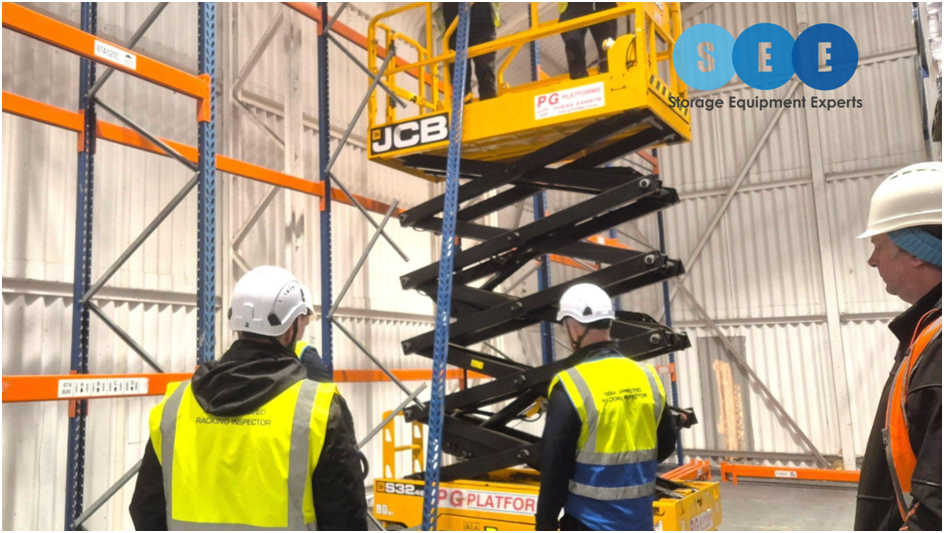
While developing an internal rack repair team is a proven way to protect your staff and prevent operational downtime, high-quality maintenance requires high-quality instruction. The Rack Maintenance Training Course from SEE Racking Inspections is specifically designed to provide your personnel with the exact theoretical knowledge and practical competence needed to maintain compliance and structural safety.
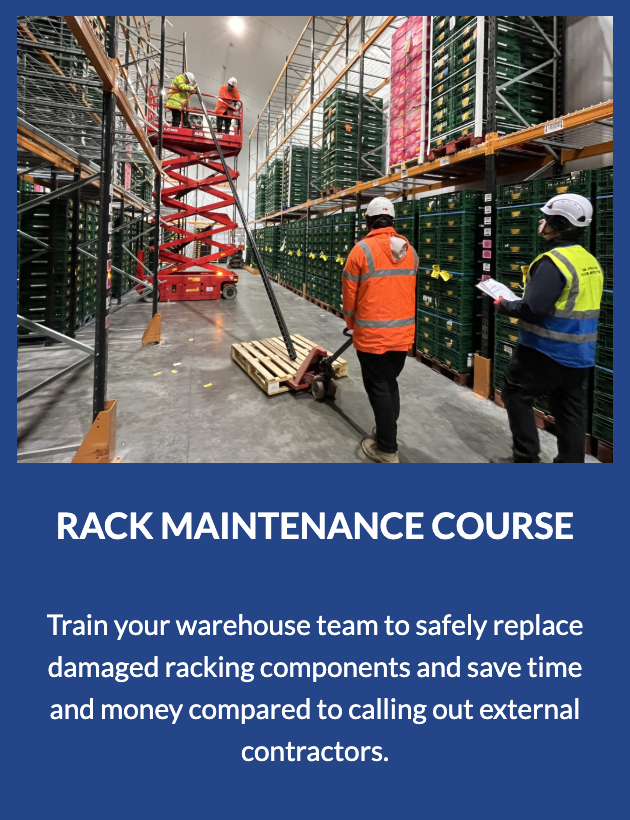
Our comprehensive rack maintenance course (which lasts 5 to 6 hours) is delivered completely on-site at your facility, allowing your staff to train under real-world warehouse conditions. The first half focuses on theory, covering BS EN 15635 requirements, damage classification, PPE, risk assessments and recognised SEMA best-practice guidance, including the SEMA Code of Practice for the Use of Static Pallet Racking and established inspection methodologies widely used throughout the UK storage equipment industry, while the second half moves directly into your warehouse for hands-on, practical repair training. Under our professional guidance, your team will practice the safe removal and replacement of uprights, beams, bracing, and frame fixings.
All successful participants receive a Certificate of Attendance, which may not be as impressive as a PhD from Oxford, but is far, far more useful in a warehouse environment. Get in touch with SEE Racking Inspections and build professional racking safety straight into your team.