
One Day Rack Maintenance Course – Assured by a RoSPA Qualification
Train Your Maintenance Team to Safely Replace Damaged Pallet Racking Components.
Rack Inspection and Rack Maintenance courses serve different purposes in warehouse safety and operations.
"*" indicates required fields
Ensure Your Racking Inspection Training Course Is Safe & Compliant!
Our one-day rack maintenance course trains your warehouse team to replace damaged pallet racking components safely.
Your team will follow a site-specific risk assessment and method statement. This helps them control hazards and manage risks during the replacement process.
Quick View
- State that this is a one-day classroom and practical course at the customer’s warehouse for experienced maintenance teams
- Designed for in-house maintenance and engineering teams
- Three to six delegates
- Site isolation requirements
- Learn to safely replace common racking components
- Certificate of attendance
- Delivered throughout the UK& Ireland
- Assured by a RoSPA Qualification

RoSPA Qualifications Course Assured
Is this Course Suitable?
This course is ideal for warehouses that already have an in-house maintenance or engineering team.
It’s particularly suitable where there is:
- Large pallet racking installations
- Regular forklift activity
- Occasional racking damage
- Scissor lifts or similar access equipment
- Experienced maintenance personnel
If your warehouse doesn’t have a maintenance team, using a specialist rack repair contractor is often the better option.
Why Choose Rack Maintenance Training?
Rather than waiting for external contractors, your own maintenance team can develop the skills needed to safely replace many common pallet racking components.
Benefits include:
- Significantly lower cost of remedial works
- Faster response when damage occurs
- Reduced operational downtime
- Improved warehouse safety
- Greater maintenance capability
- Better understanding of racking damage
What Delegates Learn?
The course combines classroom learning with a practical session covering:
- Understanding pallet racking structures
- Damage identification and classification
- Risk assessments and safe systems of work
- Working at height
- Safe replacement of common racking components
- Final safety checks before returning racking to service
Practical Training at your Warehouse
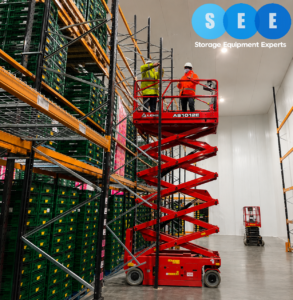
Training is delivered at your own premises using your own pallet racking. Delegates learn in a familiar environment using the same equipment they work with every day, making the training immediately relevant to your operation.
Why Train on Your Own Racking?
One of the biggest advantages of the SEE Rack Maintenance Training Course is that the practical training is carried out using the pallet racking systems your maintenance team will actually be responsible for maintaining.
Pallet racking systems differ significantly between manufacturers. Component designs, connection methods and repair procedures can all vary considerably from one racking system to another. In addition, every warehouse operates differently, with its own layouts, traffic routes, storage arrangements and operational constraints.
Training on your own pallet racking ensures delegates learn using the equipment they will work with every day, making the practical exercises immediately relevant to your business.
The practical session also reflects the planning that takes place before maintenance work begins. Prior to the course, a suitable area of racking must be unloaded and safely isolated in agreement with the Warehouse Manager or other responsible person.
This forms an important part of the learning process, helping delegates understand that successful rack maintenance is not simply about replacing damaged components—it also requires careful planning, communication and the implementation of suitable safe systems of work.
This site-specific approach provides a far more realistic and valuable learning experience than training on a generic demonstration racking system.
Course Requirements
To maintain strict UK safety learning benchmarks and deliver effective practical training on your premises, the following criteria must be met:
Ready to Strengthen your Maintenance Team?
If your warehouse has an experienced maintenance team, Rack Maintenance Training can help reduce downtime, improve safety and build in-house maintenance capability.
Contact SEE today for a free, no-obligation quotation: quotes@seerackinginspsections.co.uk
Please download our course guide for further details.
Testimonials
FAQs
A Rack Maintenance Course teaches experienced maintenance personnel how to safely replace common pallet racking components using recognised industry guidance and safe working methods. The course combines classroom learning with practical exercises carried out on your own pallet racking systems.
The course is intended for experienced maintenance engineers, facilities engineers, maintenance technicians, engineering supervisors and other members of an in-house maintenance team who already have practical maintenance experience.
No. The course is specifically designed for warehouses with an established maintenance or engineering team, suitable tools and access equipment. Warehouses without these resources are generally better served by using a specialist pallet racking repair contractor.
The course is particularly beneficial for busy warehouses with lots of pallet racking systems, regular forklift activity and an experienced maintenance team (or similar) responsible for maintaining the building, machinery and other equipment.
Training covers the safe removal and replacement of many common pallet racking components, including uprights, beams and bracingcomponents.
No. Rack Maintenance Training does not replace the need for regular racking inspections. Warehouses should continue to carry out immediate reporting of damage, routine visual inspections and periodic expert inspections as part of their overall rack safety management system. Training complements these activities by enabling competent maintenance personnel to carry out appropriate remedial works more efficiently.
Courses are delivered to a minimum of three and a maximum of six delegates to maximise practical participation and individual coaching.
The course is completed in one day which includes both classroom learning and practical training.