Do I Need a SEMA Approved Racking Inspection? UK Law and HSE Guidance Explained

Updated 2 November 2026. Technically reviewed by Justin O’Sullivan, SEMA Approved Racking Inspector (SARI).
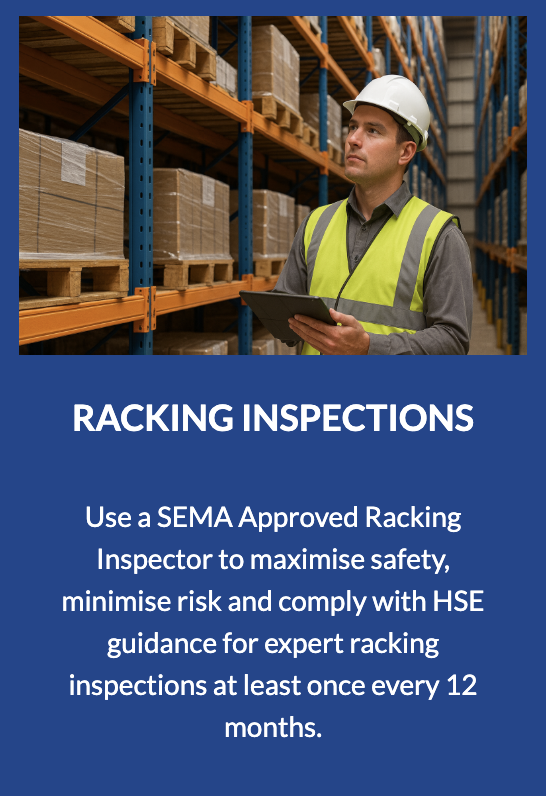
Short answer: No, UK law does not require your racking inspector to be SEMA approved. The law (PUWER 1998 and the Management Regulations 1999) requires racking to be maintained and inspected by a competent person. HSE guidance (HSG76) recommends an expert inspection at least every 12 months. Using a SEMA Approved Racking Inspector (SARI) is a recognised way to show that inspector is competent.
Does my business need a pallet racking inspection?
Whether your storage area is called a warehouse, stockroom, distribution centre, factory or retail store is not the key issue. What matters is the storage equipment you use, how it is used and the risks it is exposed to.
Loading and unloading pallet racking with forklift trucks or other materials-handling equipment (MHE) creates a risk of damage, which can become a serious safety hazard. In these circumstances, a suitable system of pallet racking inspections will normally be needed to keep the racking safe and help the employer meet its legal duties.
Does HSE define what counts as a warehouse?
No. HSE guidance covers warehouses, stockrooms and other storage environments, and the name of the premises does not decide whether racking should be inspected. The important factors are the type of storage equipment, how it is used, the likelihood of impact or deterioration, and the consequences if the system becomes unsafe.
HSE’s main warehouse guidance is HSG76 – Warehousing and storage: A guide to health and safety. It gives practical guidance on managing warehouse risks, including the inspection and maintenance of pallet racking.
Is a pallet racking inspection a legal requirement?
In Great Britain, pallet racking used at work is treated as work equipment, so the following legal duties apply:
- PUWER Regulation 5 (Provision and Use of Work Equipment Regulations 1998) requires employers to maintain work equipment in an efficient state, in efficient working order and in good repair.
- PUWER Regulation 6 requires work equipment that is exposed to conditions causing deterioration, which could result in dangerous situations, to be inspected by a competent person at suitable intervals, and after exceptional circumstances that could affect its safety.
- The Management of Health and Safety at Work Regulations 1999 require employers to assess the risks to their employees, which includes risks from damaged or overloaded racking.
HSG76 is HSE guidance rather than law. It explains how racking safety and inspection can be managed in practice. Following HSE guidance is not compulsory, but if you do follow it you will normally be doing enough to comply with the law.
In practice: if pallet racking is used where it can be damaged, especially where forklifts or other MHE operate around it, you will normally need a properly managed inspection system to identify damage, manage risk and meet your legal duties. Our racking inspection law and guidance page explains the position in more detail.
Do I need a SEMA approved racking inspector?
Not by law. HSG76 says the expert inspection should be carried out by a technically competent person. This may be a suitably trained specialist within the business, a specialist from the rack supplier or an independent qualified inspector.
The SEMA Approved Racking Inspector (SARI) scheme is a recognised industry qualification specifically for expert racking inspection. SARIs are independently assessed and must maintain their competence through Continuing Professional Development (CPD).
While SARI status is not a legal requirement, it gives businesses a recognised way to identify an inspector who has been assessed as competent in expert racking inspection. SEMA also makes clear that it approves the inspector, not the inspection itself. For more, see the SEMA technical FAQs.
How often should pallet racking be inspected?
HSG76 recommends a three-level approach:
- Immediate reporting of damage: report damage or safety concerns straight away. A clear reporting system should be in place and understood by everyone who works in or around the racking.
- Regular visual inspections: carry these out weekly, or at another regular interval set by risk assessment, and keep a formal written record. Our free racking inspection checklist can help.
- Expert inspection: a technically competent person should carry this out at intervals of no more than 12 months, with a written report setting out observations and any action needed.
Source: HSE, HSG76 (section on the inspection of racking).
Does the size or type of premises matter?
A small stockroom, retail storage area, factory, office, data centre, museum, power-generation site or major distribution centre may all use storage equipment that needs inspection. Base the decision on the type of racking, how it is used, the likelihood of impact or deterioration and the consequences of failure, not simply on whether the premises is called a warehouse.
Does shelving need inspecting too?
Not every shelving installation carries the same risk as forklift-loaded pallet racking. Lightweight office shelving presents very different risks from industrial longspan shelving, high-bay storage or pallet racking.
Inspection arrangements should therefore reflect the type of equipment, how it is used and the risks present. A simple starting point is to ask how likely it is that something could go wrong, such as stock falling or the shelving becoming unstable, and what the consequences would be.
If you are unsure what level or type of inspection is right for you, send us photographs of your storage equipment and we can help guide you.
What should a good racking safety system include?
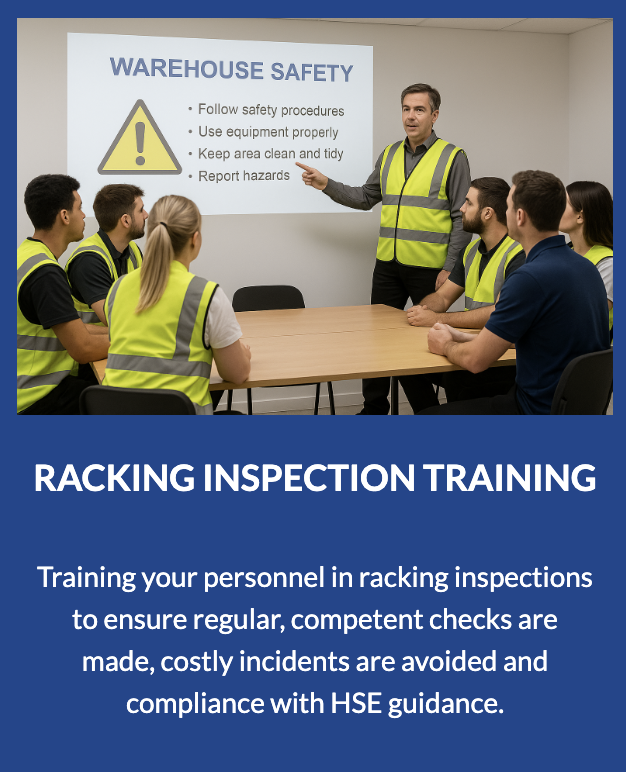
- Suitable racking inspection training and information for employees who work in and around pallet racking.
- A clear, simple system that lets anyone working around the racking report damage or other safety concerns immediately.
- A nominated Person Responsible for Racking Safety (PRRS), or equivalent, to manage the racking safety system, including recording damage, coordinating remedial action and making sure unsafe racking is not left in use. See our PRRS training course.
- Regular visual inspections, weekly or at another interval set by risk assessment, with formal written records.
- An expert inspection by a technically competent person at intervals of no more than 12 months, with a written report setting out observations and any action needed.
Frequently asked questions
In Great Britain, PUWER 1998 requires employers to maintain work equipment and, where deterioration could lead to danger, to have it inspected by a competent person at suitable intervals. HSE guidance HSG76 explains how to do this for racking, including an expert inspection at least every 12 months.
No. The law requires a competent person, and HSG76 recognises different routes to competence. The SEMA Approved Racking Inspector (SARI) scheme is an established specialist qualification and a recognised way to show an inspector is competent, but it is not a legal requirement.
HSG76 recommends immediate reporting of damage, regular visual inspections weekly or at another interval based on risk assessment, and an expert inspection by a technically competent person at intervals of no more than 12 months.
The name of the premises does not decide the need for inspection. Stockrooms and retail storage areas may need inspections too. Consider the type of equipment, how it is used, the likelihood of damage and the consequences of failure.
HSG76 describes a nominated Person Responsible for Racking Safety (PRRS) who manages racking safety. The PRRS makes sure regular inspections take place, receives damage reports and receives the written expert inspection report.
Need more detail on the law and guidance?
Our Racking Inspection Law and Guidance page explains the different frameworks for Great Britain, Northern Ireland and the Republic of Ireland.