
Pallet Racking Inspections
SEMA Approved Racking Inspectors (SARI)
Ensure 100% HSE (HSG76) compliance and warehouse safety with unbiased inspections from the UK’s leading independent specialists.
"*" indicates required fields
Ensure Your Racking Is Safe & Compliant!
What Exactly is a Pallet Racking Inspection?
A pallet racking inspection carried out by a SEMA Approved Racking Inspector (SARI) provides an independent expert assessment of the safety, condition, and suitability of your warehouse storage systems.
One of the primary objectives of a racking inspection is to identify any damage that may compromise the structural integrity of the installation. The inspector will also assess whether the racking has been installed correctly and in accordance with the manufacturer’s specifications and industry best practice.
In addition to identifying damage and installation issues, the inspection evaluates the suitability of the storage equipment for your specific warehouse operation. This includes identifying unsafe loading practices, operational risks, and any factors that may increase the likelihood of damage or failure.
The inspection will also assess floor conditions, the condition and suitability of stored pallets, and whether pallets are positioned correctly within the racking system. Accurate and clearly visible load notices will be checked to ensure operators have access to essential safe loading information.
Any hazards, defects, areas of concern, or non-compliances identified during the inspection are documented within a detailed report, together with recommendations for corrective action. This enables warehouse operators to reduce risk, improve safety, maintain compliance with HSE and SEMA guidance, and help prevent costly racking failures, product loss, or potentially catastrophic rack collapses.
In the UK, Pallet racking is generally regarded as work equipment under the Provision and Use of Work Equipment Regulations 1998 (PUWER). As a result, employers and others responsible for the safety of this equipment have a legal duty to ensure that racking systems are maintained in a safe condition and inspected regularly. In addition, HSE guidance contained within HSG76 recommends that expert inspections are carried out at intervals not exceeding 12 months. An annual expert inspection therefore forms an important part of demonstrating compliance, maintaining a safe warehouse operation, and reducing the risk of costly accidents or downtime.
The “Traffic Light” Safety System
Our SEMA Approved Racking Inspectors (SARIs) don’t just identify faults; they classify them using the industry-recognised Traffic Light System. This enables warehouse operators to clearly understand the severity of any damage and the urgency of any corrective action required.
A comprehensive report and schedule of recommended remedial works are then provided, giving competent repair specialists and racking suppliers the information they need to address safety-critical defects and ensure the storage system remains safe and compliant.
🔴
Red Risk (High): Critical damage has been identified. The affected rack must be unloaded immediately and taken out of service until the necessary corrective action has been completed.
🟡
Amber Risk (Medium): Damage has been identified that exceeds acceptable safety limits. The affected rack should be unloaded as soon as practicable (and within 4 weeks of detection) and must not be reloaded until the necessary corrective action has been completed.
🟢
Green Risk (Low): Minor damage has been identified that remains within acceptable safety limits. No immediate action is required; however, the damage should be recorded and monitored during future inspections.
Why Is This Assessment Critical for Your Business?
A professional assessment by SEE Racking Inspections does more than simply demonstrate compliance. It helps to protect your people, assets, and operations by ensuring that your storage equipment remains safe and fit for purpose.
Staff Safety: Protecting employees and visitors by identifying damage and safety risks and ensuring appropriate corrective action is taken before they result in incidents or rack collapse.
Asset Protection: Reducing the risk of damage to stock, equipment, and infrastructure caused by damaged, defective, or overloaded racking.
Insurance Validity: Providing evidence that your business is taking reasonable steps to manage warehouse safety risks and comply with recognised industry guidance.
Operational Continuity: Helping to prevent costly downtime, operational disruption, and unplanned expenditure associated with racking failures and warehouse accidents.
Written by Justin O’Sullivan SEMA Approved Racking Inspector (SARI)
Explore Common Racking Systems
Use our identifier to recognise and understand the most common racking types.

Adjustable Pallet Racking
The most versatile racking solution for all warehouse applications.
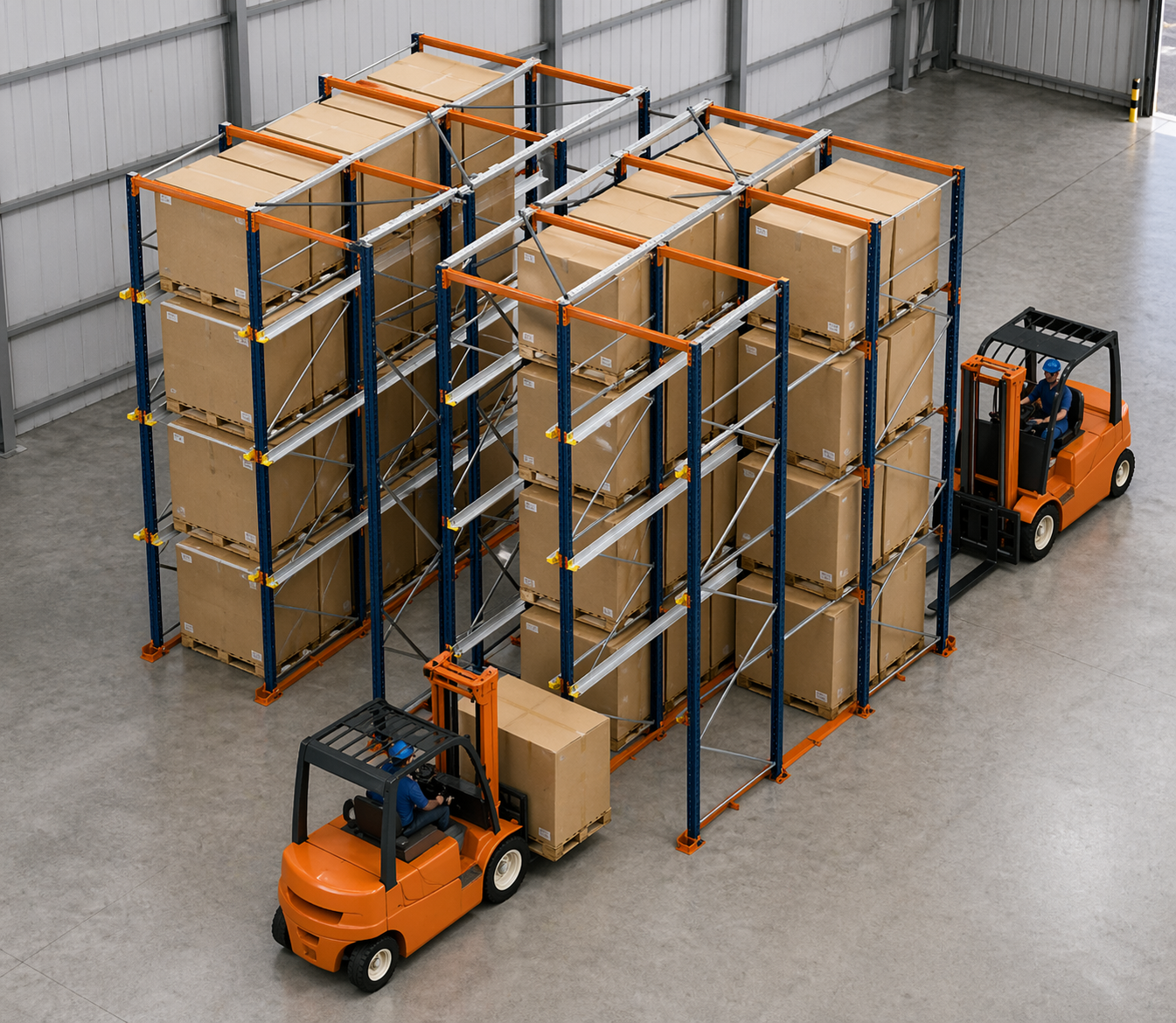
Drive-In Pallet Racking
High-density storage with fewer aisles for maximum space utilisation.

Cantilever Racking
Ideal for storing long, bulky or awkward items.
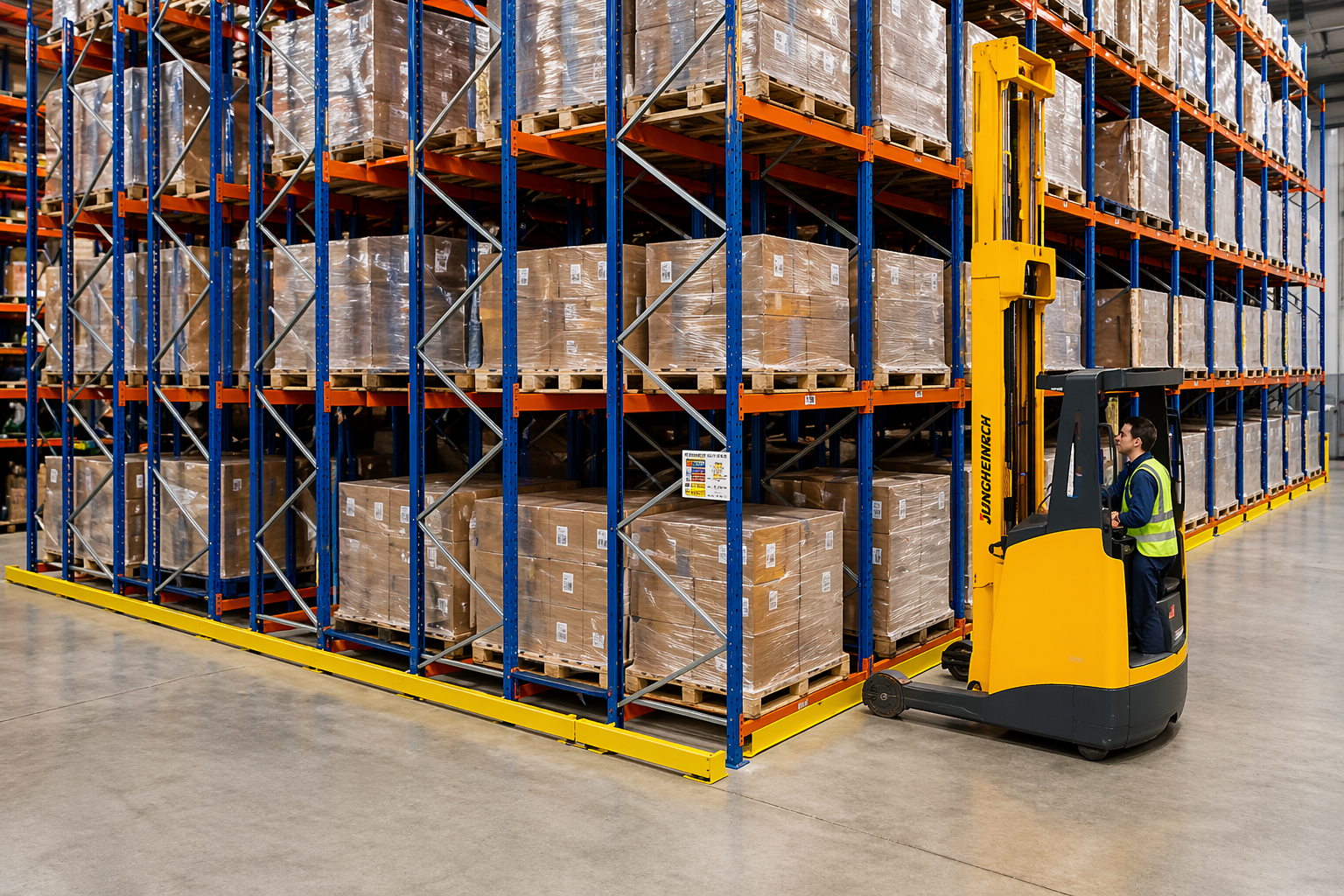
Push Back Racking
High-density system with multiple pallet depths.
What Our Inspections Cover
We conduct a comprehensive ’top-to-bottom’ inspection of your warehouse storage equipment to assess its condition, safety, and compliance with SEMA & HSG76 guidance. Our inspections examine both the racking structure and its day-to-day use, helping to identify damage, safety risks, and areas requiring corrective action.
Uprights & Bracing
Identifying impact damage, twists, bends, and other structural defects that could affect the strength, stability and integrity of the racking system.
Beams & Safety Locks
Checking for beam damage, excessive deflection (bowing), and displacement, while verifying that all beam safety locks are correctly fitted and secure.
Floor Anchors & Shims
Ensuring base plates are securely anchored and that shims are correctly installed to maintain rack alignment and stability.
Weight & Load Signage
Verifying that load notices are present, clearly visible, and accurately reflect the safe working load of the racking installation.
Safety Barriers & Mesh
Inspecting rack protection systems, including upright protectors, end-of-aisle barriers, and anti-collapse mesh, for condition and effectiveness.
Pallet Placement
Assessing pallet condition, placement, and load handling practices to identify risks such as overhang, instability, and falling objects.
Google Reviews


-
Verry informative
John Mason
March 19, 2026Happy days
Raymond Mowat
January 14, 2026Learned a lot of things that I didn't think of, instructor was very good with learning and a bit of a laugh as well
Andrew Ewan
January 15, 2026 -
Excellent course. Very well presented. Very interesting information.I didnt even fall asleep, and I was awake until midnight the previous night completing an online exam.
shirley-ann keith
January 15, 2026Very informative racking inspection course by perry lamprell
Luke Koener
January 15, 2026Really engaging and interesting training. Has given me lots of confidence in an area I am inexperienced in. Highly recommend
greg shepherd
February 2, 2026 -
I fine it hard to do stuff like the on line but I think I have learnt a bit more about the level of damage ect
brian dear
March 3, 2026This course was very informative and was extremely well presented. Would definitely recommend.
sy ellis
March 19, 2026Well presented,very informative
Alison Noble
January 14, 2026
FAQs
Yes. Under the Provision and Use of Work Equipment Regulations 1998 (PUWER), pallet racking and shelving systems are classified as work equipment.
PUWER Regulation 6 (2)(a) requires that work equipment exposed to conditions that may cause deterioration and result in dangerous situations is inspected at suitable intervals to ensure it remains safe for use.
As pallet racking is susceptible to damage from forklift impacts, overloading, and general wear and tear, employers have a legal duty to ensure it is inspected and maintained in a safe condition.
To help businesses comply with these legal obligations, HSE Guidance HSG76 (Warehousing and Storage: A Guide to Health and Safety) recommends that storage equipment is inspected regularly and that an expert inspection is carried out by a technically competent person. SEMA recommends that this expert inspection is undertaken by a SEMA Approved Racking Inspector (SARI) at intervals not exceeding 12 months.
HSE states within HSG76:
“Following the guidance is not compulsory and you are free to take other action. But if you do follow the guidance you will normally be doing enough to comply with the law.”
For this reason, an annual expert inspection by a SEMA Approved Racking Inspector is widely regarded as the industry standard for demonstrating compliance, maintaining safe storage systems, and reducing the risk of accidents or rack collapse.
More info can be found here: Visit Now
HSE Guidance HSG76 and SEMA recommend that pallet racking is inspected by a technically competent person, often referred to as an “expert”, at intervals not exceeding 12 months.
In practice, this expert inspection is typically carried out by a SEMA Approved Racking Inspector (SARI), who has the training, experience, and technical competence to assess the condition, safety, and suitability of your storage equipment.
The annual expert inspection complements the regular in-house inspections carried out by your Person Responsible for Rack Safety (PRRS) or other trained in-house personnel, helping to ensure that any damage, safety concerns, or compliance issues are identified and addressed before they become serious risks.
MORE INFO ON TRAINING YOUR WAREHOUSE TEAM HERE: Visit Now
Yes. Many insurers expect businesses to demonstrate that they are actively managing workplace risks and maintaining their storage equipment in a safe condition.
A racking inspection carried out by a SEMA Approved Racking Inspector (SARI) provides documented evidence that your storage equipment has been independently assessed by a technically competent expert and that any identified risks are being actively managed.
A professional inspection report can help demonstrate that your business is taking a proactive approach to warehouse safety, risk management, and compliance with recognised industry guidance such as HSG76 and SEMA recommendations.
A SEMA Approved Racking Inspector (SARI) is a highly qualified specialist who has successfully completed SEMA’s rigorous training and assessment programme.
SARIs are also required to undertake annual Continuing Professional Development (CPD), ensuring they remain up to date with current industry standards, inspection techniques, and best practice guidance.
SARI accreditation is widely recognised as the highest standard of competence for racking inspections in the UK.
SEE Racking Inspections is completely independent and specialises exclusively in racking inspections and rack safety training.
Unlike racking manufacturers, suppliers, or repair companies, we do not sell racking systems, replacement components, or repair services. This means our recommendations are entirely objective and based solely on the condition, safety, and compliance of your storage equipment.
Our clients value our independence, technical expertise, practical advice, and clear reporting, giving them confidence that every recommendation is made purely in the interests of safety and compliance.
At SEE, racking inspections and rack safety training are all we do. It is our speciality and our sole focus. Every day, our team of inspectors work with all industries from small independent businesses to some of the largest warehouses, distribution centres, manufacturers, retailers, and logistics operators across the UK and Ireland, assessing the safety and condition of their storage equipment.
Having inspected thousands of sites throughout the UK and Ireland, there is a strong likelihood that we have worked in facilities very similar to yours. This breadth of experience allows us to quickly identify risks, recognise common issues, and provide practical recommendations that help businesses improve safety, maintain compliance, and protect their investment in storage equipment.
When you choose SEE Racking Inspections, you’re choosing an experienced team of independent specialists dedicated to helping you protect your people, your products, and your business.
A professional racking inspection assesses far more than obvious damage.
The inspection typically includes:
- Uprights, beams and bracing
- Missing or damaged safety locks and components
- Rack alignment and structural stability
- Impact damage
- Beam deflection under load
- Condition and suitability of pallets
- Floor condition and fixings
- Installation quality
- Load notices and capacity information
- Safe loading practices
- Housekeeping and operational risks
Any defects, hazards, or areas of concern are documented and risk assessed.
We inspect a wide range of warehouse storage systems, including:
- Adjustable pallet racking
- Cantilever racking
- Drive-in and drive-through racking
- Push-back racking
- Pallet live storage systems
- Carton live storage systems
- Shuttle racking systems
- Automated Storage and Retrieval Systems (ASRS)
- Shelving systems
- & many other types of industrial storage equipment
Our inspections are designed to minimise disruption.
In most cases, normal warehouse operations can continue while the inspection is carried out. In fact, inspecting loaded racking often provides additional benefits, allowing the inspector to assess beam deflection, pallet positioning, and loading practices under normal operating conditions.
The duration depends on the size and complexity of the installation.
Smaller warehouses may take a few hours, while larger facilities or multi-site operations may require a full day or longer.
Any damage identified during the inspection will be classified using the SEMA Traffic Light Risk Classification System.
The inspection report will explain the severity of each issue and provide recommendations for corrective action, helping you prioritise repairs and maintain a safe working environment.
Any Red Risk concerns found identified during the inspection will be brought to the immediate attention of the site contact before the inspector leaves site.
SEMA uses a recognised risk classification system to help warehouse operators prioritise action.
Red Risk – Serious damage requiring immediate action. The affected area should be unloaded and isolated until repairs have been completed.
Amber Risk – Damage that requires attention but does not present an immediate danger. The affected rack should be unloaded as soon as practicable (and within four weeks of detection) and must not be reloaded until the necessary corrective action has been completed.
Green Risk – Minor damage or observations that should be recorded and monitored during future inspections.
MORE INFO HERE: Visit Now
Yes.
Regular in-house inspections carried out by your Person Responsible for Rack Safety (PRRS) are an essential part of rack safety management, but they do not replace the need for an independent expert inspection.
The annual expert inspection provides a more detailed technical assessment and helps ensure compliance with HSE and SEMA guidance.
HSE recommends that expert inspections are carried out by a technically competent person.
In the UK, the recognised benchmark is a SEMA Approved Racking Inspector (SARI), who has undergone specialist training, assessment, and ongoing professional development.
Choosing a SARI helps ensure your inspection is completed to recognised industry standards.
We use a modern digital reporting system and typically issue reports on the day or within one to two working days of the inspection.
Reports include high-resolution photographs, defect descriptions, risk classifications, recommended actions, summary findings, and detailed inspection records.
No.
SEE Racking Inspections is completely independent and does not carry out repairs or sell replacement components.
This independence ensures that every recommendation is objective and based solely on safety considerations, compliance requirements, and the condition of your storage equipment, rather than potential sales opportunities.
Our inspection reports are designed to be clear, detailed, and easy to follow. In fact, many racking suppliers and repair contractors regard our reports as some of the easiest in the industry to work from, enabling them to quickly identify damaged components, understand the scope of remedial works required, and provide accurate quotations for repairs.
This means you benefit from genuinely independent advice, together with a practical inspection report that can be used effectively by whichever repair provider you choose.
The cost depends on several factors, including the number of rack bays, warehouse size, type of storage equipment, number of sites, and location.
Contact us for a free, no-obligation quotation tailored to your specific requirements.
Typically, we require your warehouse location, the approximate number of rack bays, and the type of storage equipment installed.
Photographs showing the racking systems and warehouse layout are also extremely helpful, as they allow us to better understand the installation and provide a more accurate and fair quotation.
Yes.
Any significant forklift impact should be investigated immediately, even where there is no obvious visible damage.
Structural damage can occur to uprights, bracing, beams, floor fixings, or baseplates without being immediately apparent. If a rack has been struck, it should be assessed by a competent person (typically your PRRS) and, where necessary, inspected by a SEMA Approved Racking Inspector.
Failing to inspect your racking can allow damaged components, unsafe loading practices, and other hazards to go unnoticed. This increases the risk of product damage, operational disruption, injury, or even a rack collapse.
HSE Enforcement
In the event of a serious incident, the Health and Safety Executive (HSE) may investigate whether appropriate inspection, maintenance, and risk management procedures were in place. Where significant failings are identified, enforcement action, improvement notices, fines, or prosecution may follow.
Insurance Implications
Failure to adequately inspect and maintain storage equipment may also affect insurance claims. Insurers often expect businesses to demonstrate that they have taken reasonable steps to maintain a safe working environment and manage foreseeable risks. If damaged or unsafe racking is found to have contributed to an incident, insurers may scrutinise whether appropriate inspection and maintenance procedures were being followed and whether the business had complied with recognised industry guidance.
Business Interruption and Downtime
A damaged racking system may need to be unloaded, isolated, or taken out of service immediately. This can severely disrupt warehouse operations, delay customer orders, and reduce storage capacity until repairs are completed.
Product and Stock Loss
A racking failure can result in substantial damage to stock, particularly high-value products. In some cases, entire rack runs may collapse, causing losses far exceeding the cost of routine inspections.
Damage to Forklift Trucks and Equipment
When racking fails or collapses, forklifts, conveyor systems, automated equipment, and other warehouse assets can also be damaged, resulting in additional repair or replacement costs.
Reputational Damage
A serious warehouse incident can affect relationships with customers, suppliers, employees, and insurers. Businesses may suffer reputational harm, particularly if investigations reveal that known risks were not being managed appropriately.
Increased Repair Costs
Minor damage identified early is often relatively inexpensive to rectify. If left unaddressed, that damage can worsen over time, leading to more extensive repairs, replacement components, or even partial rack replacement.
Reduced Storage Capacity
Damaged racking may need to be unloaded or removed from service until repairs are completed. This can reduce available storage locations and affect warehouse efficiency.
Employee Morale and Retention
Employees are more likely to feel confident and productive when they work in a safe environment. Visible damage that is not addressed can undermine confidence in management’s commitment to safety.
Difficulty Demonstrating Due Diligence
If an incident occurs, businesses are often expected to demonstrate that they had suitable inspection, maintenance, and reporting procedures in place. Inspection reports provide valuable evidence that storage equipment has been monitored and risks have been managed appropriately.
Impact on Accreditations and Audits
Many businesses operate under quality, health and safety, or customer audit requirements. Poorly maintained storage equipment or a lack of inspection records can result in non-conformities during audits and inspections.
Regular racking inspections help identify problems before they become serious safety hazards, protecting employees, stock, equipment, and the long-term operation of the business. They also provide documented evidence that your organisation is taking a proactive approach to warehouse safety, compliance, and risk management.
Yes. Visible damage is only one of many factors that can affect the safety, strength, and suitability of a racking system.
Many forms of damage can go unnoticed during day-to-day warehouse operations, particularly when they involve uprights, bracing, beams, floor fixings, or other structural components. In addition, a professional inspection assesses far more than physical damage alone.
A SEMA Approved Racking Inspector (SARI) will also evaluate factors such as installation quality, load notices, beam deflection, pallet condition, loading practices, floor conditions, rack alignment, and the overall suitability of the storage equipment for your operation.
It is common for issues to be identified during an expert inspection that were not previously recognised by warehouse personnel. Many of these issues may not present an immediate risk but can reduce the safety margin of the racking system or lead to problems if left unaddressed.
For this reason, HSE Guidance HSG76 and SEMA recommend that pallet racking is inspected regularly and that an expert inspection is carried out by a technically competent person at intervals not exceeding 12 months, regardless of whether any obvious damage has been identified.
Regular inspections help ensure your storage equipment remains safe, compliant, and fit for purpose while providing documented evidence that warehouse risks are being actively managed.


